No You Know Theres a Difference Constantine
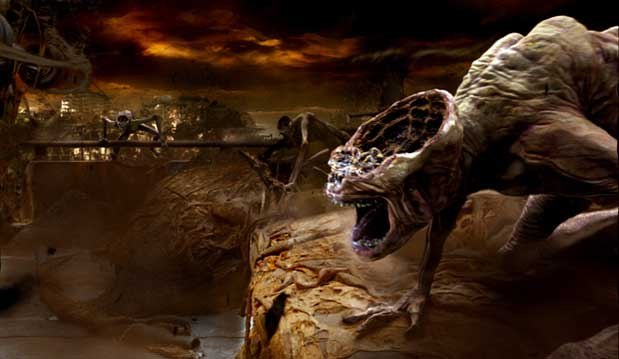
Constantine was one helluva challenge for the f/ten wizards. All Constantine images © 2005 Warner Bros. Ent. Inc. All rights reserved.
From What Dreams May Come to Spawn to Bedazzled, Hollywood keeps sending film characters to hell and vfx artists continue struggling to visualize it in an imaginative and disarming way. Since heaven and hell are ultimately very personal beliefs, information technology is almost incommunicable to create imagery that will satisfy everyone. This turned out to be a major challenge for anybody involved in Francis Lawrences Constantine, the big screen version of the Hellblazer graphic novel (the title was changed to avoid defoliation with the Hellraiser franchise). Supernatural detective Constantine (Keanu Reeves) has literally been to hell and back. This traumatic journey left him with special powers that he uses to hunt evil on World. He is approached past constabulary officer Angela (Rachel Weisz), who wants to solve the mysterious suicide of her twin sister. Their investigation takes them to a world of demons and angels that exists just beneath our reality
The task of putting Lawrences vision on screen was awarded to overall visual furnishings supervisor Mike Fink: I had just finished X-Men 2 for producer Lauren Schuler-Donner when she asked me to supervise Constantine. Originally, the script called for 250 shots, but we ended up creating more 500 shots. I had six or seven vendors on that projection. The main facilities were Tippett Studio, ESC (in what would eventually be their last project), CIS Hollywood, Hydraulx and Hatch FX.

Overall visual effects supervisor Mike Fink and Tippett Studio co-founder and visual effects supervisor Craig Hayes.
Designing A New Hell
From the offset, Lawrence wanted to stay away from the traditional imagery of bonfires, horns and pointy tails. He had very specific ideas about what hell should look like. Francis had been impressed past footage of nuclear blasts that he had seen, explains Fink. Right earlier the shockwave, in that location is a oestrus wave that melts everything away. You can really see surfaces being superheated before the whole thing is blown away. Francis wanted this moment to form the basis for the look of hell in the motion picture. His idea was that hell is a parallel universe. It exists in some other dimension as a complete replica of our globe. Yous have the same buildings, the same streets, and the same rooms. The difference is that everything seems to be perpetually hit by a nuclear heat moving ridge. This universe keeps decaying forever. It merely never stops. We started to await at nuclear blasts footage and our main source of information was the material that Peter Kuran of Visual Concept Technology had been able to declassify for the Television picture The Day Later (1984). Some other major source of inspiration was the disturbing piece of work of Polish artist Zdzislaw Beksinski. His paintings of decaying corpses and corroded universes actually echoed Francis vision.
In one major sequence, Constantine goes back to hell and arrives on a freeway littered with hundreds of car wrecks, while a hellish downtown Los Angeles looms in the background. The sequence was executed past Tippett Studio, equally were all the movies hell shots. The state highway sequence was photographed on a 80-foot big set surrounded past a greenish screen, notes Craig Hayes, co-founder and visual effects supervisor. Our task was to extend this environment and create a hellish rendition of the real Los Angeles. The question was: what would the urban center look like if information technology were eternally hit by a nuclear heat wave? From a conceptual point of view, it was pretty challenging.

Stan Winston Studios' Aaron Simms (inset) created the maquette, which the demon Mammon was based on. Images courtesy of Tippett Studio.
A World of Particles
Tippett Studio did a Lidar scan of the set up and sent a coiffure to downtown Los Angeles to run a like task on the main buildings. Reference photographs of the façades were as well taken. Although the action is supposed to take identify in Los Angeles, the freeway set matched no real location. We took a very stylistic approach to L.A., confirms Hayes. Some buildings are non where they should be. It is sort of a mythical view of the urban center. Using Maya, we modeled all the structures and street elements ability lines, streetlights, copse in the reckoner. These models were and so laid out in low resolution to create a CG version of the city. In one case the position of each element was approved, we figured out which i had to exist in loftier resolution. We then created a matte-painting of the city that was projected onto the CG geometry. The skies were also matte-paintings that were designed to lucifer the wait and texture of a thermonuclear cloud. Rendering was handled in RenderMan while Shake was the compositing tool.
The adjacent pace was to create the billions of particles that period through the scenery. In the footage of an atomic blast, yous can see the surfaces melting down and thousands of tiny elements being scattered past the nuclear wind, adds Hayes. We tried to lucifer that by rigging our models to generate an endless flow of particles. Each shot contains upward to 60 layers of particle elements. We wanted people to virtually smell it! The action was photographed without any dust on the set, although there were huge air current machines generating the appropriate turbulences on the actors. It gave us clean plates onto which nosotros could build particle layers in a very controlled way.
Equally if this terminate-of-the-earth environs was non enough, hell happens to be the dwelling house of some terrifying creatures: the scavengers who walk the streets and the seplavites who fly. Both hunt downwardly the hopeless humans and devour them. Worst of all, the victims never truly die. After each horrifying decease at the creatures hands, they come up back and the hunt starts all over again. This is like Groundhog Day in hell, observes Fink. Everything keeps happening again and again. And each decease makes the side by side one more painful every bit the victims remember what it was like and they too know that there is no stop to it. They will exist devoured over again
The full general wait of the creatures was conceived past production designer Naomi Shohan with input from Lawrence and Fink. While doing enquiry for Constantine, she came across photographs of corpses in an dissection room. The bodies were all shrunken and the meridian of the head had been cut off at heart level to allow access to the encephalon area. The director deemed these images to be really compelling and approved the concept. Aaron Simms of Stan Winston Studios was then brought in to blueprint the creatures. Afterward a maquette had been approved, Tippett Studio scanned it and used the data equally the basis for the CG model. We ran blitheness tests and found that the graphic symbol was too skinny, reveals Hayes. Information technology looked fine equally a static model, only when it moved, it tended to expect similar a terminate movement armature. So, we added well-nigh fifteen pounds of flesh to beefiness him up. In terms of blitheness, we found it difficult to convey emotion or personality without eyes. They really are the soul of a character. In social club to recoup, we worked a lot with body language, overdoing at times the blitheness to make a bespeak. We made some really graphic moves in the shoulder and manus areas. We as well cheated a trivial chip by adding glitter in the eye area to advise that there were, after all, eyes in in that location
Confronting Hell Minions
Simultaneous to the creation of hell itself, Tippett Studio was responsible for many manifestations of hell on Earth. Ane of them involved the fight of Constantine against the Vermin Human being, a brute made of millions of bugs and maggots. As the grapheme is able to appear and disappear at will, plate photography required Reeves and three stuntmen to perform a complex choreography. The stuntmen played the Vermin Man at different positions around Constantine and helped the actor to focus his centre line and accommodate body language. They were after painted out by Tippett Studio and replaced past a reckoner-generated Vermin Human.
Originally, the sequence was awarded to ESC and the facility produced such spectacular results that 14 extra shots were deputed. However, in the meantime, ESC had folded and could no longer contribute to the project. Fink then awarded the extra shots to Tippett Studio. Interestingly enough, the concept was similar to the sequence that nosotros had created for Matrix Revolutions in which Neo speaks to a confront fabricated of thousands of flight machines, observes Hayes. Nosotros started by modeling different maggots and created about a dozen blitheness cycles. We then used a particle animation organization to apply these cycles to the thousands of maggots that formed the shape of the characters body. Officially, the Vermin Man is comprised of millions of bugs, but when we got to 50,000 individual models, render time became unmanageable. We ended upward cheating a lot non to exceed 50,000 models while still creating the illusion of having millions of them on screen.
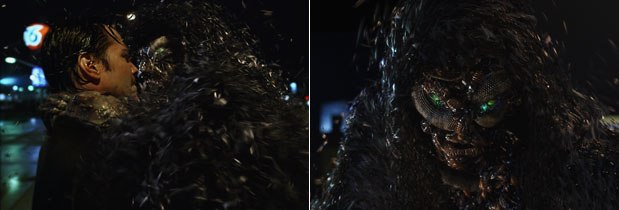
Tippett Studio had to bug out on the creation of Vermin Man. Images courtesy of Tippett Studio.
Tippett Studio besides tackled two exorcism sequences. In the starting time one, Constantine extracts a demon out of the body of a little girl and traps it into a large mirror. This sequence was filled with challenges, comments visual effects producer Jay Heapy. How would the demon interact with the mirror? What would the mirror world await like when the demon entered information technology? What happens when the demon reaches back through into our earth? The manager knew what he wanted, but he likewise allowed u.s.a. to run with his ideas and effort new things. Nosotros did a lot of studies in how the demon would get from the possessed girl to the mirrors surface, the smudges it left on the mirror, how the cracks and holes in the mirror formed and looked. The shots were photographed in an actual apartment with a practical mirror. A greenscreen set up backside the window fabricated lighting a claiming since we had to establish what kind of highlights or lighting the director wanted based on an unknown source.
The second exorcism sequence involves Angela and Mammon, a powerful demon hiding inside her. Through out the shots, Mammon fights with Angela and, at times, stretches her tummy with his confront. Early on on, it became obvious that any sort of physically based simulation would fall apart quickly, explains Heapy. The team started the simplest fashion possible: our CG Mammon pushes up through a simple cloth-like canvas modeled to friction match Angelas breadbasket. Nosotros looked at the results and came upward with ways to make it look better: we put some dampening geometry between Mammon and the sheet; we as well had Mammons hands control how the canvas folded, stretched, and relaxed; finally, we fabricated it so the veins and other internal layers could move differently from side by side layers to help prove that Mammon was pushing through lots of stuff.

In this exorcism scene, visual effects producer Jay Heapy (inset) said the crew had to come up with a practical approach to bring the scene to life. Images courtesy of Tippett Studio.
From Hell to Heaven
During the climax of the flick, one character is taken to heaven. The sequence was awarded to Hatch FX and executed by founder and lead matte-painter Deak Ferrand. Interestingly, the artist had already created (for Pacific Ocean Post) the famed sequence of the heavenly city in What Dreams May Come and also contributed to Hellboy. I dont know if sky and hell are becoming Deaks trademark, merely I exercise know that, although the sequence comprised five shots only, it was extremely important to the movie, observes Fink. Nosotros had very little screen time for these shots, and yet, they had to carry a lot of weight. I think nosotros did our task correct, because the audience loves these shots.
Alain Bielik is the founder and special effects editor of renowned furnishings mag S.F.Ten., published in France since 1991. He also contributes to diverse French publications and occasionally to Cinefex. He only finished organizing a major special effects exhibition that will open February. 20 at the Musée International de la Miniature in Lyon, French republic. Displays include original models and creatures from 2010 Odyssey Two, Independence Day, Ghostbusters, Cliffhanger, Alien Vs. Predator, Alien 3, Pitch Black and many more. The exhibition will run through Aug. 31.
Source: https://www.awn.com/vfxworld/going-hell-and-back-nuclear-blast-constantine
0 Response to "No You Know Theres a Difference Constantine"
Post a Comment